A Personal Archive for One Small Collection
A personal archive for a small collection turns postcards or prints into a quiet viewing sequence, making it easier to compare details without displaying everything.
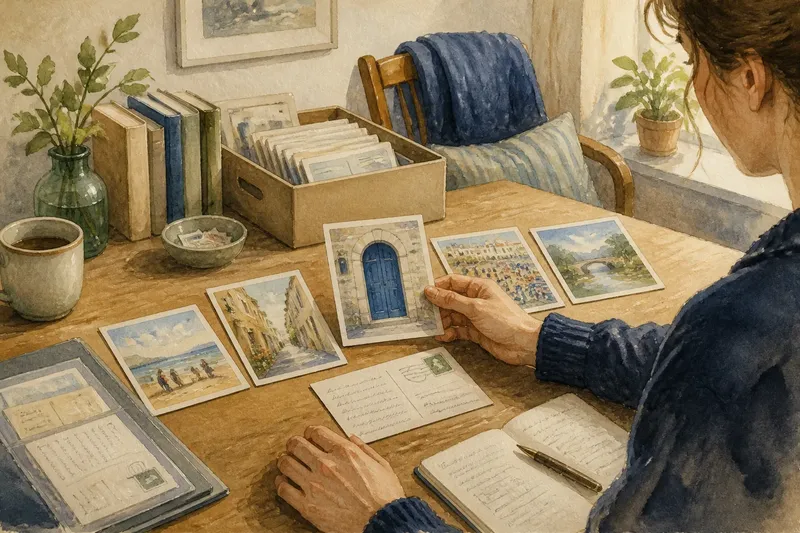
You have postcards spread across the dining table: one has a blue doorway, another a crowded beach, and a third a handwritten note on the back. A personal archive for a small collection gives these objects a viewing order, so you can look closely without putting every card on the wall. The aim is not to make a miniature museum. It is to shape a private encounter with a few things at a time.
Choose the room and the kind of attention it allows
Start with the room where you are most likely to pause, rather than the room that seems most presentable. A bedroom chair, a desk cleared after work, or a quiet corner near a window can all serve. Think about how long you tend to stay there and whether you want to sit, stand, or handle the pieces.
Light and movement matter. A place with steady, indirect daylight can make colours easier to compare, while a busy passage may turn looking into a brief glance. Avoid putting paper where sunlight falls strongly or where damp, cooking vapour, or frequent handling could damage it. For a precious or fragile item, ask a conservator or another qualified professional about suitable care.
Decide whether the collection will be visible on a wall, kept in a folder or box, or arranged temporarily on a table. These are different viewing experiences. A wall holds a selection in place; a folder lets you change sequence and inspect the backs; a table makes side-by-side comparison easy. You can combine them, but choose one as the main way you want to look.
Gather the collection without sorting it into a story
Bring together the postcards or prints you might include, along with any sleeves, folders, or display materials you already have. Clear a surface and lay the items face up, leaving enough room to move them without stacking. If you have notes about where an item came from, keep those nearby, but do not let the notes decide the arrangement before you have looked.
Begin by noticing visible qualities: dominant colours, repeated shapes, differences in scale, borders, marks, and the direction in which figures or lines seem to lead the eye. For postcards, also consider whether the reverse carries a message, stamp, or other detail you want to include in the viewing. These observations give you several possible paths through the group without requiring a theme in advance.
Set aside anything that feels too delicate to handle or display in the chosen room. The rest can be considered for this particular viewing sequence. A personal archive is not an inventory of everything you own; it is a changing selection made for attention.
Choose one question to guide the sequence
A useful sequence begins with a question small enough to answer by looking. You might ask how different artists use a doorway, how a single colour changes across several images, or what happens when a quiet scene is placed beside a busy one. A question gives the arrangement direction without forcing the objects to illustrate a grand claim.
Write the question on a scrap of paper, or keep it in mind as you move the pieces. Then choose a handful that make the comparison visible. Include contrast as well as resemblance: a series of nearly identical blue views may be restful, but one image with a warm accent could help you notice what the blue is doing.
Say you have five postcards showing buildings, and you want to compare how their windows shape the image. You might begin with the card where the windows are most regular, place a more crowded façade beside it, and finish with a view where the windows are barely visible. The expected result is a sequence in which the eye can move from clear repetition towards a less obvious pattern, rather than a row that simply groups all the buildings together.
Arrange the order for comparison
Make a rough line or arc on a table, or place paper slips where items would hang. Start with the image that makes the question easiest to see. Follow it with a piece that changes one feature, then another that complicates or loosens the comparison. The final item need not provide an answer; it can leave you with a detail to revisit.
Try more than one order before fixing anything. A sequence might move from similar to different, from close-up to distant, or from a full image to one with a striking detail. Keep the route simple enough to follow at a glance. If two cards seem to compete, separate them with an image that gives the eye a pause, much as a comma lets a sentence breathe.
For a wall arrangement, check the sequence from the chair or standing place where you will usually view it. For a folder, put the cards in the intended order and turn through them at an unhurried pace. If the comparison disappears when you move away from the table, adjust the order or choose a different place for the viewing.
Decide how each piece will be held and seen
For a temporary arrangement, place prints on a clean, dry table and avoid sliding them across one another. If you use a folder, choose sleeves or pages that suit the paper and allow the items to be removed without forcing a corner. For wall display, use a frame or mounting method appropriate to the material; do not put adhesive directly on an original print or postcard.
Check the product label and follow the maker’s instructions for sleeves, frames, and mounting materials; local rules may also apply to shared or rented spaces. If a piece is valuable, brittle, or already showing damage, get advice from a qualified conservator rather than improvising a mount.
Leave enough room around each item for its edges and surface to be read. A postcard can be displayed with its reverse included in a nearby pocket or as a second view in the folder. If you want to show a message, consider whether you are comfortable with other people reading it; private viewing can include information you would not choose to put on a public wall.
What helps a private viewing feel inviting?
How many postcards or prints should I include?
Include only as many as you can compare without losing sight of your guiding question. If the sequence starts to feel like a catalogue, remove a piece or save it for another viewing.
Should the backs of postcards be part of the display?
Include them when handwriting, stamps, or paper marks add something you want to notice. A folder makes it easy to turn a card over; for a wall display, keep the reverse accessible without attaching anything directly to the card.
Can I change the arrangement often?
Yes. Treat the sequence as a temporary reading of the collection, not a permanent verdict about what belongs. Keep a note of the question or order if you want to return to it later.
What if two pieces seem to belong together?
Place them together once, then try separating them with a contrasting image. The change can reveal whether their connection comes from a shared subject, a repeated shape, or simply the fact that they were acquired as a pair.
Leave a small record and return with fresh eyes
Keep a simple note with the date you arranged the group, the question you followed, and any order you want to remember. A few words are enough: “windows, regular to hidden” or “blue, interrupted by orange”. This record preserves the path of your looking without turning a modest collection into paperwork.
When you return, look first at the gaps between the items and the transitions from one to the next. Ask whether the sequence still supports comparison or whether a different question has become more interesting. You can exchange one print, reverse the order, or put the whole group away and bring out another selection.
A personal archive for a small collection works best when it remains easy to revisit. Keep the viewing place clear, store unused pieces safely, and let each arrangement hold just one conversation among the objects. The next time you sit down, you can begin with a detail you did not notice before.