The Natural Gesture on Stage Is a Useful Myth
Natural gesture on stage is shaped by choice: see how repeated movement, timing and context help an audience read a character’s intentions.
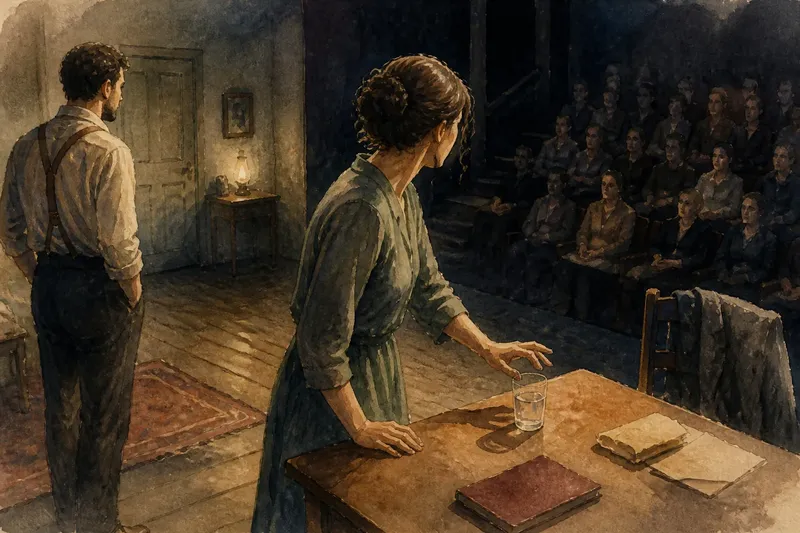
A performer reaches for a glass, then stops with a hand hovering above it. From the back row, that small pause may speak louder than a line of dialogue. Natural gesture on stage is not movement untouched by artifice; it is movement shaped so an audience can read it.
The idea of “natural” action remains useful, but not as a claim that performers simply behave as they would at home. On stage, gesture is selected, repeated and adjusted for meaning. These choices do not make a performance false. They let its human details travel across a room.
1. A gesture is chosen, even when it looks unplanned
Everyday movement is full of habits we scarcely notice: a shoulder lift, a glance towards a door, fingers worrying a sleeve. A performer may draw on such familiar actions, but placing one in a scene gives it emphasis. The audience sees it because the rest of the moment makes space for it.
That emphasis can make a gesture seem spontaneous. A character turns away just as a difficult question is asked; the movement feels like a reflex, yet its position in the scene gives it dramatic force. The actor’s choice lies not only in making the turn, but in when to make it and how long to remain turned.
Think of gesture as a word in a sentence. A familiar word can carry a different meaning according to its place and emphasis. Likewise, a hand brushing a table might suggest impatience, affection or simple attention, depending on what has happened around it.
2. Repetition makes movement legible
When a gesture returns, spectators can compare its new appearance with the old one. The repeated movement need not be identical. A character might begin the play by smoothing a cuff when trying to appear composed, then do it later with a hurried, uneven touch. The familiar action now reveals a change in control.
Repetition also helps an audience recognise a character’s physical vocabulary. A speaker who repeatedly angles their body towards the exit may seem ready to flee, even while insisting they intend to stay. The gesture becomes meaningful through recurrence, not because that posture has one fixed translation.
This is why a repeated gesture should not be treated like a coded signal with a single answer. Context changes its meaning. A clenched hand can mark restraint in one scene and resolve in another; the audience reads the shift through the surrounding words, relationships and events.
3. Timing gives a small movement its weight
A gesture can alter a scene simply by arriving early or late. If someone reaches for another person’s hand before an apology, the action may feel like an attempt to control the conversation. If the reach comes after the apology, it may read as a tentative offer of repair.
Pauses matter for the same reason. A held look can invite the audience to notice what a quick glance would pass over. But a pause does not automatically create depth; it needs a reason in the scene, such as a character deciding what to reveal or waiting for someone else to respond.
Timing also includes the relation between bodies. One performer may start to move while another remains still. That contrast can make hesitation visible without either actor explaining it. The audience sees a decision unfolding between them, rather than being told what each person feels.
4. Scale determines what reaches the audience
A movement that is clear at close range may disappear in a large theatre. A barely raised eyebrow can register in an intimate studio, while a distant audience may need a broader shift of the head or torso. The answer is not to make every action large; it is to decide which details carry the scene’s meaning.
Stage scale includes more than the size of a gesture. Lighting, costume, set and sightlines all affect what can be seen. A dark sleeve against a dark wall may swallow a hand movement. A performer partly hidden behind furniture may need to communicate through posture or voice instead.
These conditions are part of the performance’s form, not obstacles to be ignored. A movement can be vivid in a close-up film and unreadable from the balcony; another can appear broad on stage but feel excessive on camera. The audience’s viewing position changes what counts as clear.
5. Repetition can reveal a social rule
Gesture is shaped by more than individual personality. People learn how to occupy space, offer a greeting, show deference or claim attention within particular communities. A performance can make those learned conventions visible by repeating them, changing them or placing them under pressure.
For instance, a character might lower their eyes whenever a powerful figure enters. The action could suggest respect, fear, habit or strategic concealment. Its meaning depends on the relationship and the production’s context; the same movement does not mean the same thing across every culture or situation.
Careful staging avoids treating a gesture as a universal shorthand for a whole group. Instead, it gives the action a specific place in the character’s world. Who expects this behaviour? Who benefits from it? What changes when the character stops complying? Such questions turn a physical habit into part of the drama.
6. A gesture can contradict the spoken line
Words and movement do not always agree, and that gap can make a scene more alive. A character may say, “I’m pleased you came,” while keeping their coat on and their body angled towards the door. The mismatch lets the audience hear both the welcome and the wish to end the visit.
Contradiction does not have to mean that one signal is honest and the other is a lie. A person can feel affection and resentment at once, or try to be generous while protecting their own position. Gesture gives those competing impulses a visible form without resolving them too quickly.
Imagine a fictional scene in which Mara tells her brother she has forgiven him, then folds a letter into a precise square instead of looking at him. If the letter has already mattered to their conflict, the careful folding may suggest that forgiveness is real but incomplete. The audience can observe the tension without being handed a final verdict.
7. What makes a stage gesture feel natural?
Does natural movement mean copying everyday behaviour?
Not exactly. Familiar behaviour can provide a starting point, but performance selects and organises it so its purpose remains visible in the scene. A stage gesture may be more deliberate than its everyday counterpart while still feeling believable.
Why repeat a gesture instead of inventing a new one?
Recurrence gives spectators something to recognise and compare. A repeated action can show habit, pressure or change, provided the surrounding situation gives it fresh meaning rather than using it as a fixed code.
Can a gesture mean different things to different audiences?
Yes. Cultural knowledge, personal experience and the production’s context shape how movement is read. Clear staging can guide attention, but it cannot make every spectator interpret a gesture in precisely the same way.
Should every movement have a hidden meaning?
No. Bodies also move to manage practical needs, respond to the space and support ordinary interaction. A performance becomes strained if every hand or glance is treated as a symbol, so emphasis matters more than decoding everything.
Natural gesture on stage depends on chosen detail
The myth of effortless naturalness can be helpful when it reminds performers not to display emotion mechanically. It becomes limiting when it suggests that stage movement should simply happen without choice. Audiences do not need to see the work behind every gesture; they do need enough shape, timing and context to follow its effect.
When watching a scene, notice what returns, what changes and what remains unsaid between a line and a movement. That attention makes natural gesture on stage easier to understand as crafted communication: not a copy of life, but a set of human actions made visible at the moment they matter.