Before the Conductor’s Baton: How Ensembles Kept Time
How ensembles kept time before the baton: see how breath, gesture, pulse and shared leadership help players coordinate entrances and changes.
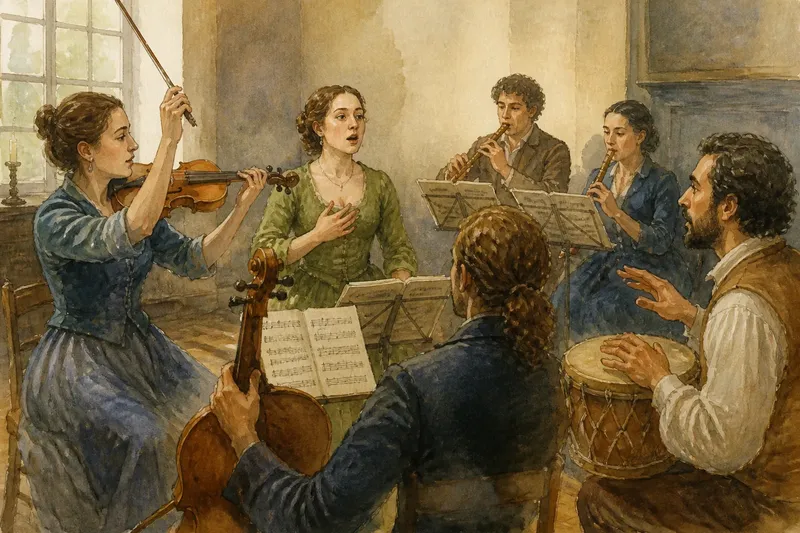
A violinist lifts her bow as the singer beside her draws a breath. Across the room, a drummer watches the violinist’s wrist. No baton is in sight, but the group is ready to begin. How ensembles kept time before the baton depended on shared cues such as breath, movement, sound and a musician’s leadership.
Players use several cues to share a pulse
Imagine a clearly hypothetical rehearsal in a small hall. Singers, string players, a hand drummer and wind players are preparing a short piece. Its opening has a steady pulse, followed by a passage that gathers before moving on. The players know their parts, but they still need to agree on the start, the feel of the pulse and who will cue the change.
The singer takes an audible preparatory breath, and the string players raise their bows with it. The drummer marks a soft pulse while the wind players follow the phrase’s shape. Each cue offers different information: a shared inhale can prepare an entrance, while the direction of a bow can suggest how a sound should move.
Musicians do not need to watch one person every moment. They listen across the group and notice movements nearby. The pulse is not only a beat to follow; it is also a relationship, as each player adjusts to the others.
A leader can make time audible and visible
In this invented rehearsal, the group asks the drummer to lead the opening. The drummer taps a clear pulse and makes a larger gesture before the first sound. In many musical settings, a leader can mark time by tapping, singing, stamping or playing an instrument, while also cueing entrances and transitions.
The task is more than keeping a steady beat. The players must also coordinate phrase endings, changes in volume and moments when the pulse relaxes. A singer may breathe early to prepare an entrance; a player farther away may need a visible cue if the tap is hard to hear. The leader combines signals, and the rest of the group reads them in context.
Think of the pulse as a handrail on a staircase. It gives people a shared reference, but each person still chooses how to move and where to pause. The players must keep listening and responding.
The baton clarifies some visual gestures
For the gathering passage, the group tries a different arrangement. A designated leader stands where more players can see and uses a small stick to clarify the direction of the beat. A baton can make gestures easier to see across a group and help distinguish a precise beat pattern from a broader movement of the arm.
It cannot make every cue self-explanatory or replace listening. The leader still needs to make movements readable, and musicians interpret them alongside the sound. A slight lift may prepare an entrance; a change in the breadth or firmness of a gesture may suggest emphasis. The group’s shared habits help those movements make sense.
In the imagined rehearsal, the wind players watch the leader’s gesture at the gathering passage, while the drummer keeps a quiet pulse. The singer still shapes the phrase with a breath, and the strings notice one another’s bows. These cues work alongside one another; the baton has a particular job, not sole command of the music.
When does a group need a visible leader?
Can musicians keep time without a conductor?
Yes. Players can coordinate through listening, a shared pulse, breathing and visible cues from one another. A designated leader can still help with entrances or transitions, even if nobody conducts throughout.
What might lead a group before a baton is used?
A musician could mark time through voice, an instrument, tapping or bodily gesture. The useful signal depends on what the players can hear and see, and on the music they are performing.
Does a baton keep the beat by itself?
No. It can make some gestures easier to see, but the leader must shape clear cues and the players must interpret them. Listening remains part of keeping together.
The rehearsal shows how cues divide the work
In the invented hall, the drummer taps the pulse, the leader gives a visible preparation, the singer breathes into the opening and the strings follow a shared motion. At the gathering passage, the leader’s baton helps the wind players see the change; they also hear the drummer and shape their phrases together. One cue does not replace the others: each helps with a different part of coordination.
To hear ensemble timekeeping, notice who establishes the pulse, who signals the next entrance and which cues help the group change direction. Those roles can belong to different people or shift during a piece. Before the conductor’s baton, as in this imagined rehearsal, musicians could coordinate by combining audible and visible signals.
Next time a group plays, listen for a breath that prepares an entrance and watch for a bow lifted in response. Those small, concrete cues can reveal who is helping the ensemble begin together.